
Grocery Store App Not Working? The In-Store Signal Trap Explained
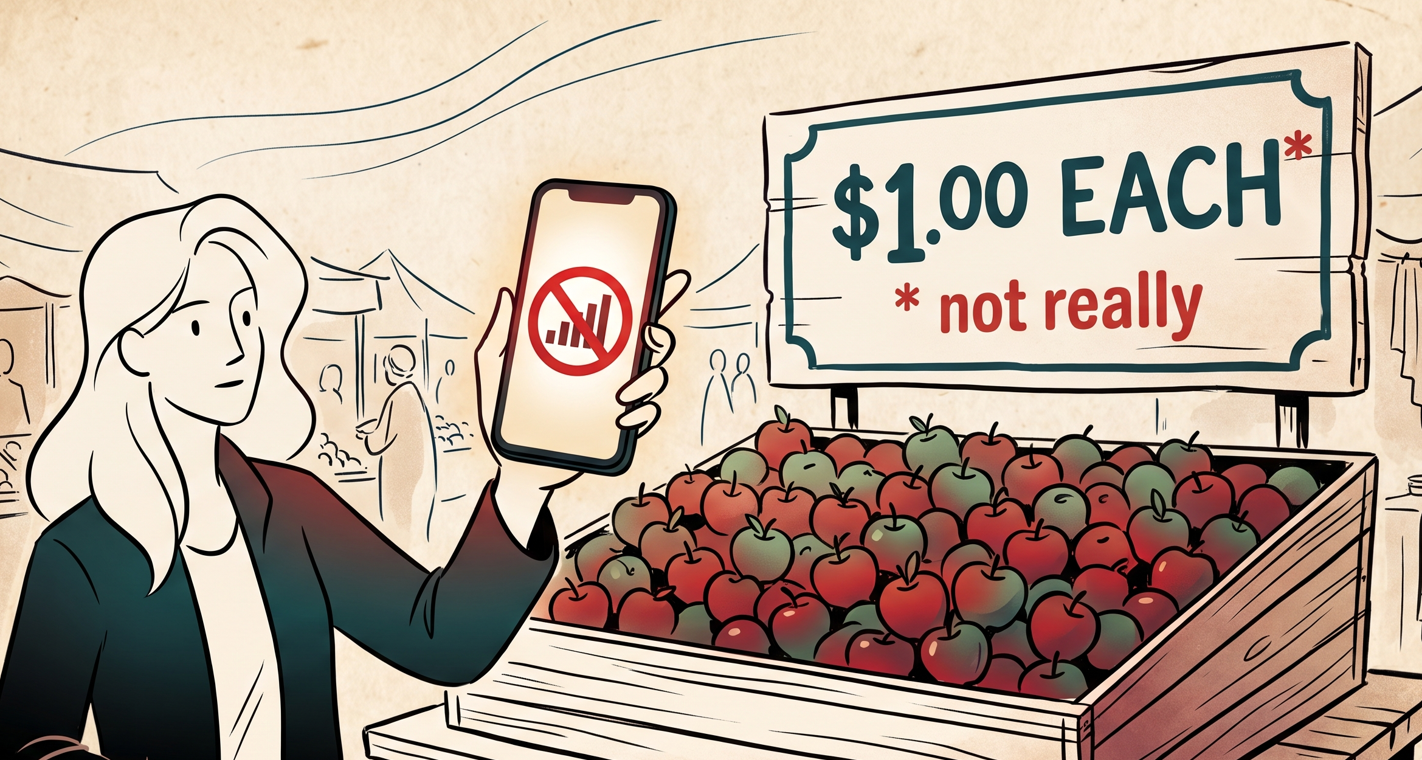
Table Of Contents
- Grocery Store App Not Working? The In-Store Signal Trap Explained
- Overview
- The "Faraday Cage" Effect in Modern Supermarkets
- Why Technical "Dead Zones" Cross the Legal Line
- Your Rights Under Illinois's Digital Coupon Fairness Law
- What to Do If an App Fails in the Aisle
- Speak to a Chicago Consumer Fraud Lawyer
Grocery Store App Not Working? The In-Store Signal Trap Explained
Overview
Some grocery stores in Illinois offer digital coupons that can only be redeemed via a smartphone. They often advertise the 'disouncted' price in large font, and may have very small font that describes the process for redeeming the discount and the full price in small print. On top of that, the advertised price may be inaccessible because the store itself has little to no cellular signals inside its walls.
If you have been forced to pay full price due to a malfunctioning app, misleading shelf tags, or a lack of smartphone access, you are not alone—and you may have been a victim of a deceptive retail practice - please contact us ASAP..
This isn't always an accident of geography—it is often a direct result of how modern supermarkets are built. When a store demands you connect to the internet to get an advertised price but operates a facility that blocks your signal, a promotional campaign may turn into an unlawful misleading claim or consumer hurdle.
WERE YOU CHARGED FULL PRICE? If you were locked out of an advertised grocery discount because of a broken app, lack of smartphone access, or zero cellular signal inside an Illinois store, we want to hear from you. Click here to talk with an attorney today.
The "Faraday Cage" Effect in Modern Supermarkets
If your phone works perfectly in the parking lot but drops to zero bars the moment you walk past the sliding glass doors, you may be experiencing what engineers call a "Faraday cage."
Major grocery chains build their retail warehouses using heavily reinforced materials designed for structural durability, not cellular penetration:
- Thick poured concrete walls
- Interlocking structural steel beams
- Corrugated metal roof decks
- Low-E energy-efficient glass window coatings that reflect radio waves
These materials form a highly effective shield that blocks external cellular frequencies from reaching your phone. While this architecture keeps construction costs down and temperatures regulated, it fundamentally isolates your device. When retailers deploy an app-based pricing model inside a building structure that acts as a signal blocker—without installing public Wi-Fi or cellular repeaters—they create an environment where the lower price is structurally impossible for many to obtain.
Why Technical "Dead Zones" Cross the Legal Line
Under the Illinois Consumer Fraud and Deceptive Business Practices Act (ICFA) (815 ILCS 505/1 et seq.), unfair methods of competition and unfair or deceptive acts are unlawful:
unfair or deceptive acts or practices, including but not limited toincluding but not limited to the use or employment of any deception fraud, false pretense, false promise, misrepresentation or the concealment, suppression or omission of any material fact, with intent that others rely upon the concealment, suppression or omission of such material fact ... in the conduct of any trade or commerece are hereby declared unlawful whether any person has in fact been misled, deceived or damaged thereby.
Grocery stores have actual or constructive knowledge of the dead zones within their own retail footprints. Forcing a consumer to complete an online condition precedent to secure an advertised contract price, while simultaneously cutting off their physical access to the network required to fulfill that condition, is inherently oppressive.
Rather than fixing the signal issues or providing open, high-speed Wi-Fi networks that don't require intrusive data harvesting, some chains simply pocket the extra revenue when frustrated shoppers give up and pay full price at checkout.
Your Rights Under Illinois's Digital Coupon Fairness Law
Because of the systemic nature of this issue, the Illinois General Assembly passed House Bill 45, which directly bans the digital coupon trap.
The law mandates that if an Illinois retail establishment utilizes digital-only promotions, it must ensure those discounts are practically accessible on-site to all consumers. If an app fails to load because of an in-store cellular dead zone, the retailer is legally required to provide an immediate, non-digital workaround at the register—such as an automatic point-of-sale override or cashier-assisted discount.
Failing to provide a seamless manual fallback when their technology fails is no longer just poor customer service; it is a statutory violation of Illinois consumer protection law.
What to Do If an App Fails in the Aisle
The next time a grocery store app crashes or refuses to load due to zero signal strength, build your evidence trail directly from the store floor:
- Screenshot the Error: Take a snapshot of your phone screen showing the empty signal bars, the infinite loading screen, or the network timeout message while standing next to the product display.
- Photograph the Product and Sign: Capture a clear photo of the shelf tag displaying the low promotional price so you can prove what you were led to believe the item cost.
- Demand a Register Override: Bring the issue to the checkout lane or customer service desk. Explicitly state that the in-store network failure is preventing the app from loading, and request that they manually apply the sale price. Note down their name and policy if they refuse.
Speak to a Chicago Consumer Fraud Lawyer
Retailers cannot hide behind architectural dead zones to escape their advertised pricing obligations. If you are tired of paying full price because of broken grocery apps and dead cell zones, you have a right to seek reimbursement and push for structural changes in how these stores operate.
Click here to talk with an attorney today to share your experience with our legal team and find out if you qualify as a potential class representative.