
Digital Coupons and Dead Zones in Illinois Grocery Stores: A Bait and Switch Investigation
Digital Coupons and Dead Zones in Illinois Grocery Stores: A Bait and Switch Investigation
Overview
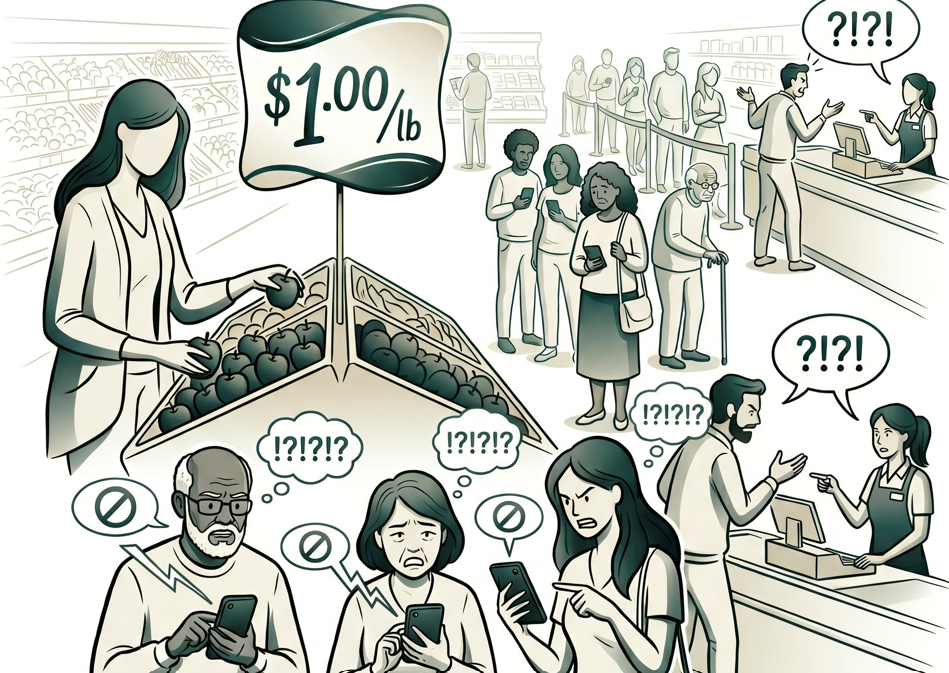
Have you ever walked down the produce or checkout aisle of an Illinois grocery store, seen a massive sign advertising a great deal—like a bag of apples for $1.00—only to get hit with a $4.00 charge at the register? If so, you may have been a victim of a deceptive retail practice - please contact us ASAP..
If you look closely at the fine print on those signs, it usually says something like "Must 'clip' digital coupon in our app." For thousands of Illinois shoppers, this requirement has turned grocery shopping into a modern trap.
To get the advertised sale price, major retailers force you to open their proprietary app, search for the item, and "digitally clip" a barcode while standing on the sales floor. The critical issue? Inside these large, concrete-and-steel grocery stores, cellular service is frequently non-existent.
Without a working internet connection, the app won't load, the coupon cannot be clipped, and consumers are forced to either abandon their groceries or pay a massive markup at the register.
If this has happened to you at an Illinois grocery store, you may have been subjected to an illegal retail practice. Our firm is currently investigating these "digital dead zones" as potential violations of Illinois consumer protection laws.
WERE YOU CHARGED FULL PRICE? If you were locked out of an advertised grocery discount because of a broken app, lack of smartphone access, or zero cellular signal inside an Illinois store, we want to hear from you. Click here to talk with an attorney today.
The Deceptive Strategy Behind Digital-Only Discounts
Under the Illinois Consumer Fraud and Deceptive Business Practices Act (ICFA) (815 ILCS 505/1 et seq.), it is unlawful for businesses to engage in unfair or deceptive practices. A retail practice is considered legally deceptive or unfair if it misleads a reasonable consumer or if it is oppressive, unethical, and causes substantial financial injury.
Forcing a shopper into a structural trap where the low price is prominently displayed but functionally impossible to obtain fits this definition for several reasons:
- Misleading Visual Impression: Giant headline signs scream the low price (e.g., "$1.00!"), while the restrictive terms are buried in tiny print or placed out of sight. Under longstanding Illinois case law, a fine-print disclosure does not automatically cure a misleading advertisement if the overall net impression deceives the consumer.
- The "Faraday Cage" Oppression: Forcing a consumer to perform an online task inside a physical location where cellular signals are blocked—without providing store Wi-Fi or a manual checkout workaround—is inherently oppressive.
- Targeting Vulnerable Shoppers: This framework heavily discriminates against senior citizens and individuals who may not own smartphones, lack high-speed data plans, or are not technologically adept.
Illinois Moves to Ban the Digital Coupon Trap
This issue has become so severe that the Illinois General Assembly recently stepped in to protect consumers.
The legislature passed House Bill 45, which directly targets these digital promotion barriers. Under this new measure, any major retail mercantile establishment operating in Illinois that offers digital promotions must ensure those savings are practically accessible to all consumers.
The law mandates that stores provide an alternative, practical, non-digital means of receiving the discount at the register—such as automatic point-of-sale overrides, physical paper alternatives, or cashier assistance—if a customer cannot utilize the app. Crucially, the bill clarifies that a failure to provide these workarounds can face legal action under the state's consumer fraud laws.
How to Protect Your Rights (and Your Receipt)
If a store refuses to honor an advertised price because your phone cannot connect to their app, you do not have to accept the overcharge. To help us build an investigative framework for a potential class action lawsuit against major regional grocery chains, please take the following steps:
- Save Your Receipts: Keep physical or digital copies of any receipt where you paid "regular price" for an item you intended to buy at a lower advertised rate.
- Take Photos: If safe and legal to do so, document the in-store pricing signs showing how the discount is displayed versus how the fine print is disclosed.
- Note the Signal: Pay attention to your phone's signal bars. Note if the app fails to load explicitly because of poor signal strength in that specific part of the store.
Speak to a Chicago Consumer Fraud Lawyer
Retailers cannot hide behind technology to cheat everyday consumers out of advertised savings. If you are tired of paying full price because of broken grocery apps and dead cell zones, you have a right to seek reimbursement and push for structural changes in how these stores operate.
Click here to talk with an attorney today to share your experience with our legal team and find out if you qualify as a potential class representative.